How to Avoid TDS
Deduction by Banks - HOT TIPS FOR TDS in Banks
by
Rajesh Goyal
Ads by Google
What
is TDS?
The
full form of TDS is Tax Deducted at Source. Thus, when someone deducts tax at
appropriate rate at the time of making payment, then the amount deducted is
known as tax deducted at sources. One of the most often case for such TDS is
the deduction of the tax on the interest paid on Fixed deposits to you by all
banks. From FY 2015-16 onwards, TDS is also applicable for Recurring
Deposits. However, there is no TDS for interest earned on Saving
Bank accounts.
(A)
Tax Exemption : For FY 2015-16 (also for FY 2014-15 :Interest earned
in Saving Bank accounts upto Rs 10,000
is exempted from Tax (moreover, no TDS is applicable even if the interest
earned is more than Rs10,000/-. Interest income above Rs10,000/- is
fully taxable.
However, interest income from other kind of deposits (like from
Fixed Deposits (also called term deposits) /
Recurring Deposits ) are NOT exempted from tax. Thus, feel
free to keep upto Rs 2 lakhs in Saving Bank accounts as most of the
banks pay 4% interest in saving bank accounts. Even if you keep high
amount in Saving Bank account, there will be no deduction of TDS.
You
will need to pay tax for the interest earning in Saving Bank accounts if the
total interest in saving bank account exceeds Rs 10,000/-
(B)
Deduction of TDS : As
explained above, No TDS is
deducted by banks on interest earned in Saving Bank accounts.
However, interest earned on Fixed Deposits and Recurring Deposits are subject to deduction
of tax as per rules (Earlier Recurring Deposits were exempted from TDS but
now from June 2015 onwards, banks are required to deduct TDS even on
the interest earned on Recurring Deposits). As far as interest earned on
Saving Bank accounts is concerned, income from
interest earned on Saving Deposits beyond Mr 10,000/- p.a.only
are taxable. Thus, in nut shell we can say that NO interest income from
Fixed
Deposits or Recurring Deposits is exempted from income tax.
As explained above, now TDS is
deductible on interest earned on Fixed Deposits / Term deposits and
also on Recurring Deposits.
However, in certain conditions, no TDS is deducted even on the interest earned on fixed deposits, e.g.
if
the total interest earned on such deposit in a financial year is upto
Rs.10,000/-. However, you should be clear
in your mind that even if No TDS is deducted
on your interest earned on Fixed Deposit interest or Recurring
Deposit, you still have to include this income
in your tax return and pay tax.
(C)
Rules for Deduction of TDS on interest paid / accrued : As per present income tax guidelines, banks are required to deduct tax
at source (TDS) on deposits if the total interest
earned on all your fixed deposits / recurring deposits in a bank (at all branches of the
bank) is more than Rs.10,000
in a financial year. (as per these guidelines even if a fixed deposit is
in the name of a minor TDS is deducted). However, the
depositors can claim the credit for such TDS in their income tax
returns. (Now a days such deducted TDS is reflected in AS26 which can be
downloaded and checked before you submit your income tax return. (Even in case of minors, this credit for TDS can be claimed by
the person who manages the minor's income).
Remember, now a days as and when a bank pays an interest on
the fixed deposits / recurring deposit, it checks whether the account is exempted from TDS.
If it is not exempted, then TDS is deducted. You should also
remember that TDS is deducted even on interest accrued in case of
Fixed Deposits / Recurring Deposits (but not
yet paid) at the end of the financial year i.e. 31st March every year.
We can summarise the above details in the following
table :
Interest Earned on
Whether TDS is Applicable
Whether Income Tax is Payable on Interest income
How to Avoid TDS
Saving Bank Accounts
No
Income Tax is payable if the
interest income earned on all saving bank accounts is over Rs10.000/-.
No tax is payable for interest income in SB accounts upto Rs 10,000/-.
No Need to worry as no TDS is
deducted
Fixed Deposits
Yes, if the interest income from all
such deposits exceeds Rs10,000/- in a FY. (TDS is deducted at 10%
if PAN submitted or else it will be deducted at 20%)
Interest earned is fully taxable and
full interest income (including accrued) should be included as
your income at the time of filing the IT return. However you can claim
credit for all the TDS deducted by your bank for which bank has given
you Form 16-A and shown in AS26.
Submit Form 15 G / 15 H, if you are
eligible to submit the same. (See the details given below)
Recurring Deposits
Yes, if the interest income from all
such deposits exceeds Rs10,000/- in a FY. (TDS is deducted at 10%
if PAN submitted or else it will be deducted at 20%)
Interest earned is fully taxable and
full interest income (including accrued) should be included as
your income at the time of filing the IT return. However you can claim
credit for all the TDS deducted by your bank for which bank has given
you Form 16-A and shown in AS26.
Submit Form 15 G / 15 H, if you are
eligible to submit the same. (See the details given below)
Ads by Google
Some Queries
answered in Question-Answer format :
(a)
Whether Interest Income on Fixed Deposits and Recurring Deposits from
Bank is Taxable ?
Yes, the interest income on fixed deposits and recurring deposits is now fully
taxable, as shown in the table above. On such incomes banks are required to deduct TDS (From FY 2015-16,
even the interest accrued on Recurring Deposits will be liable for TDS). Such
an income
comes under the head “income from other sources”.
Banks are required to deduct TDS in the following cases and the rates mentioned
below : -
If
interest earnings from your fixed deposits exceed Rs. 10,000 in a financial
year, then Bank deducts TDS (Tax deduction at source) as per the following
criteria.
(a)If you have provided PAN details to the Bank then Bank would deduct TDS
at the rate of 10 %.
(b)In case you have not provided the PAN details then Bank would deduct TDS
at the rate of 20%.
(C )
Whether We Can avoid TDS to be deducted by Bank :
Yes
you can submit avoid deduction of TDS
provided you are eligible for the same. As per the present guidelines,
who does not want TDS to be deducted needs to declare that his / her income is
below the threshold limit for filing an income tax return. The following
forms are used for this purpose :-
·Form
15G- It is applicable for Individual below 60 years, HUFs and Trusts.
·Form
15H- It is applicable for individuals above 60 years.
(D)
What is the Eligibility criteria for submitting declaration forms 15G or 15H to
Banks:
Following two conditions needs to be fulfilled by you for the submission
eligibility of Form 15G or 15H.
1.The
final estimated total income calculated as per the income tax rules and
provisions should be NIL.
2.
Total interests earning should not cross the basic exemption limit of
Rs.2,50,000.
The
above will be more clear through the following example:-
Shri
Sunil Kumar, Age 55 years earns Rs. 2,60,000 from Interest from bank fixed
deposits and he also earns Rs. 40,000 from other sources. Thus, his total income
is Rs.3,00,000/- for the Financial Year.
During
the FY he invests Rs. 1,50,000 in Public Provident Fund (PPF). Now, we can find
out whether he is eligible to submit Form 15-G to avoid TDS :-
(a)Check whether he is eligible as per 1st Rule : In terms of income tax
regulations, his total estimated income is not taxable (Total Income Rs
3,00,000-Investment Rs 1,50,000 = 1,50,000). Thus he fulfills the criteria
under Rule 1 specified above.
(b)However, total estimated interest earnings are Rs2.60 lakhs. This is
higher than the interest exemption limit of Rs. 2,50,000 as per the 2nd
criteria. Thus he has not fulfilled the 2nd criteria.
Hence, he is not eligible to submit the form 15G. In this condition, Banks would
deduct the TDS on earning interest and later he can claim the excess tax
deducted at the time of filing of his return of income.
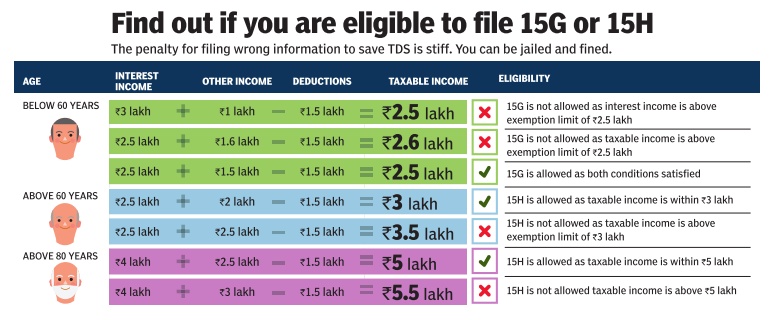
We give below a diagram, which will make it much more clear
as to whether you are eligible to file 15G / 15 H form:-
Remember that : -
(a) Even if you submit the 15G / 15H
Form, the tax which has already been deducted by way of TDS
during the year prior to submission of 15H Form, is usually
not refunded by the bank as they are under obligation to
deposit this TDS within a time bound period. . However
this TDS certificates will be issued to the customers which
he / she can
use while filing his/her tax return and get credit for the
same.
(c) 15G/15H Forms are valid only for the
particular financial year in which they are
submitted to the bank.
(d) In view of
above, usually banks ask that a fresh 15G / 15H
form for each deposit that
is placed with the Bank
(e) However, if the depositor furnishes form
15G / 15H (which are available free of cost from all banks) and therein
declares he / she does not have tax liability at all, the bank will
not deduct any TDS from the interest earned by the depositor.
(f) Thus, the above, in a nutshell indicates
that if the interest income from a bank branch is more than Rs.10,000/-
(and you have not submitted form 15G / 15H), the Bank will deduct the TDS. For any TDS deducted by the bank, it will issue a Form 16A which can be
used while filing the income tax returns. Such TDS is
also reflected in the AS26 form which can be generated from income tax
website.
(g)
Thus, in case you do not want the TDS to be
deducted, you can split your Bank Deposits in two or more
Banks so that the total interest earned at one Bank is
less than Rs.10,000/-. (However, remember this does not mean
that income earned from such deposits is exempted from income tax.
You have to club all such interest income and add to your other income,
and pay the tax while filing the income tax return.)
In Income Tax law, one of sources of the income is "Interest Income" and
thus directions issued by income tax authorities have to be followed by all
bankers.
What are the rules for deducting tax on fixed
Deposit ? When do the bank deduct TDS on a fixed deposit? :
Banks deduct tax (TDS), if
the total interest earned on all your fixed deposits in the bank is greater
than Rs.10,000/- during a financial year. The tax liability
for the purpose of TDS was earlier determined at the branch level.
The bank branches used to check interest on your fixed deposits at a
particular branch only as it was impossible to club the interest earned
in other branches. However, after introduction of CBS, now
banks are able to club such interests at different branches if Customer
ID / PAN is same. Thus, if interest earned on fixed
deposits in different branches exceeds the threshold, the TDS will be deducted
by the system. TDS is also
deducted on interest accrued (but not yet paid) at the end of the financial
year viz. 31st March every year.
Difference between form 15G and 15H
(Free
Download form 15G)(Free
Download form 15H)
: The
form 15G and 15H are submitted to
banks by depositors who DO NOT want that TDS be deducted from their
interest earned on fixed deposits. A person who is below 60 years can file
the Form 15 G . However, only
a person of 60 years or more is eligible to file Form 15 H.
There are some other major issues relating to 15G and 15 H and the same
are discussed below:-
FORM NO. 60 :[See
second proviso to rule 114B] : Form of declaration to be filed by a
person who does not have a permanent account number and who enters into
any transaction specified in rule 114B. Form of Declaration to be filed by a person who does
not have either a Permanent Account Number or General Index Register
Number and who makes payment in cash in respect of transactions specified
in clauses (a) to (h) of rule 114B
FORM NO. 61
:
[See proviso to clause (a) of rule 114C(1)]. Form of declaration to
be filed by a person who has agricultural income and is not in receipt of
any other income chargeable to income-tax in respect of transactions
specified rule 114B. Form of Declaration to be filed by a person who has
agricultural income and is not in receipt of any other income chargeable
to income tax in respect of transactions specified in clauses (a) to (h)
of rule 114B
(Updated in
August 2015)
You can give your feedback / comments about this Article. Please give only relevant comments as irrelevant comments are
waste of time for yourself and our other readers.